Springing Into White Responsibility: What This Season Is Asking of Us
Spring always asks something different of me than winter.
Where winter demanded endurance, spring invites movement and expansion. Where I’ve spent months holding, bracing, surviving, spring gently asks, what if you loosen your grip? I’m having difficulty trusting that invitation right away. Letting go and relaxing feels very vulnerable and frightening. I am still carrying the heaviness of winter; the vigilance, the quiet negotiations with uncertainty. Living with illness has taught me how much of life happens in that space: managing what can’t be fixed, surrendering what won’t change, and learning, again and again, how to stay.
But spring doesn’t wait for me to be ready. And this year, I’m noticing that my version of “blooming” looks different from the way it used to. It’s less about bursting into something new and more about allowing what’s already here to be seen. My capacity is different. My pace is different. My priorities are sharper, clearer, less negotiable. There’s a kind of honesty that illness has carved into my life. It has stripped away the illusion that I can do everything, be everywhere, carry it all. And in its place, something more intentional has taken root. It's a truth that is reshaping how I understand white responsibility.
For a long time, I absorbed the messages that responsibility meant doing more, reacting faster, proving my awareness, and staying visibly engaged at all times. But that version of “responsibility” often mirrored the very urgency, perfectionism, and disconnection that uphold white supremacy culture. It asked me to override my own limits, to perform instead of relate, to measure impact by output rather than integrity. I can’t unsee that anymore. I feel this shift deeply. I’m less interested in urgency for urgency’s sake, in performative overwhelm, in the constant push to prove worth through output. I’ve lived too closely with the limits of the body to pretend that depletion is sustainable or that burnout is noble. Instead, I find myself asking different questions. What does it mean for white people to take responsibility in ways that are sustainable, accountable, and rooted in relationships? What does it look like to move from performance to practice? How do we interrupt harm not just in what we say, but in how we show up with ourselves and with others?
Spring, for me, is not just about growth. It’s about noticing what is actually alive and honest and what we’ve been forcing. It’s about releasing the need to be seen as “good” and instead committing to being honest. It is an ongoing practice. It’s about tending to relationships that sustain justice, not just moments that signal it.
White responsibility, in this season, feels less like urgency and more like consistency.
It is less about proving and more about practicing, and less about control and more about accountability. I think about the quiet ways this shows up: staying in hard conversations without defensiveness and taking feedback without collapsing or centering myself. It's about redistributing resources without needing recognition. It looks like continuing to learn, to unlearn, to repair, long after the moment has passed and no one is watching. These don’t look like big, blooming flowers. They look like roots. Maybe that’s what this season is asking of us: not to rush toward visible transformation, but to deepen into the kind of responsibility that can actually sustain change. The kind that is less visible, less performative, but far more real.
There is still uncertainty in my life. There are still things I can’t control, but there is also love; deep, steady, grounding love. There is purpose in the work I get to do, even in small ways. There is meaning in being part of something larger than myself.
Spring doesn’t erase winter. It grows out of it. Maybe white responsibility, at its most honest, works the same way. It doesn’t start fresh each season or reset when it’s convenient. It deepens over time. It asks more of us as we learn more. It requires us to stay. So I’m learning to meet this season as I am, not as I wish I could be. To trust that even here, even now, something is unfolding and to commit, in quiet and consistent ways, to being part of that unfolding with integrity.
See you on the journey,
Robin
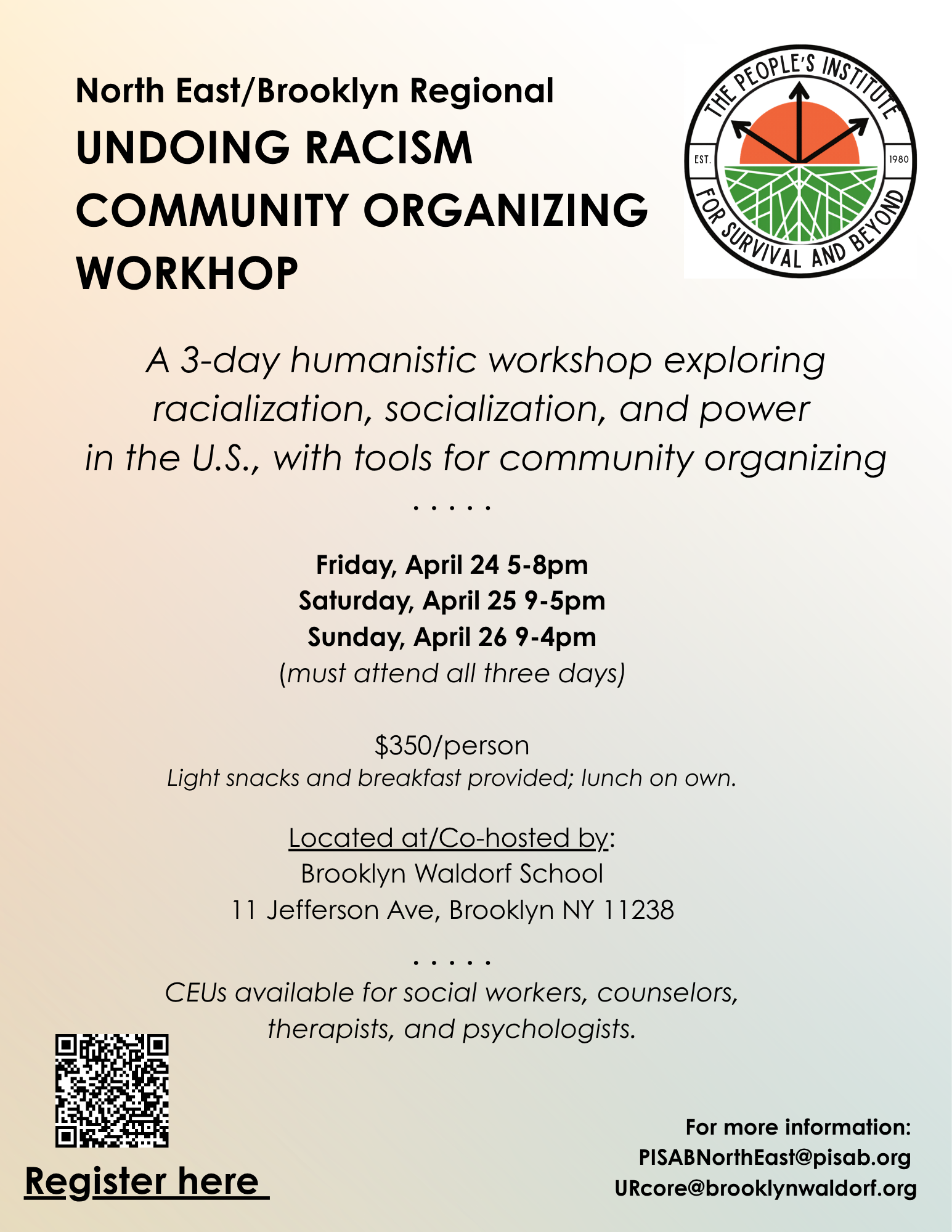
PISAB: Undoing Racism and Community Organizing Workshops: https://pisab.org/
PISAB Northeast Regional Undoing Racism Workshop In Person (Brooklyn) - This workshop will be held on Friday, April 24 (5-8 pm), Saturday, April 25 (9am- 5pm) and Sunday, April 26 (9am-4pm). All in EST.
PISAB Bread For The City - Undoing Racism Workshop: District of Columbia, Washington, DC, May 29–31, 2026 This in-person workshop occurs from May 29 from 9am-5pm, May 30 from 9am-5pm, and May 31 from 9am to 1pm. Attendance on all three days are required.
Register here: https://givebutter.com/Breadforthecityinpersonregional
The Center for the Study of White American Culture: https://cswac.org/
Books:
Me and White Supremacy by Layla F. Saad - A structured, reflective workbook that moves beyond awareness into daily accountability practices.
Emergent Strategy by adrienne maree brown - Offers a framework for building sustainable, relational change, especially helpful for rethinking urgency and scale.
Articles:
"White Supremacy Culture” by Tema Okun - A foundational piece that names patterns like perfectionism, urgency, and defensiveness, and how they show up in our work and lives.
"White Supremacy Is a Suicide Pact Disguised as a Social Order" by Fazer Domino - A powerful reflection on the broader costs of white supremacy culture, including to those it privileges.
Lastly, I was asked to share this letter and invitation in its entirety:
We are delighted to announce the next Seminar on Memory and Slavery: Social and Human Consequences, which will be held through cosponsorship with the Seminars on Human Rights and Law and Politics.
Date/Time: Thursday, April 23, 1:00pm–2:30pm ET, via Zoom.
Speaker: Professor Sheila D. Collins
Presentation: "White Conspiracy in the Mississippi Delta: The Trials and Triumph of Eddie James Carthan"
Please register for the seminar by completing this Google form.
Registered participants will receive the Zoom link on the morning of the Seminar.
Professor Collins will discuss her forthcoming book, White Conspiracy in the Mississippi Delta: The Trials and Triumph of Eddie James Carthan, which will be published by the University Press of Mississippi later this year. It tells the dramatic story of a young Black mayor, among the first to be elected since Reconstruction in a biracial town in the Mississippi Delta, who was railroaded out of office in the early 1980s by white supremacists. Because he refused to be the white power structure’s “good little boy,” he was subjected to a four-year period of harassment designed to make his governing impossible. When he still refused to bow, he was framed on four felony charges, one of which was capital murder. This book relates the gripping tale of prosecutorial misconduct in post-Civil Rights Mississippi and the dramatic multiracial civil and human rights campaign that rallied to Carthan’s defense. Collins takes the readers into the Mississippi Delta, the heart of the Old South, a land of fierce contradictions and dark secrets, where the appearance of racial progress hides widespread political corruption and where America’s “original sin” is dressed up in new clothes.
Sheila D. Collins is a sociopolitical activist and Professor of Political Science Emerita at William Paterson University, where she chaired the department and directed its graduate program in Public Policy and International Affairs. She is the author of eight books on American politics, public policy, social movements, and religion. Her book on the 1984 Jesse Jackson presidential primary campaign, The Rainbow Challenge: The Jackson Campaign and the Future of U.S. Politics, is being reissued this spring with an updated preface relating it to our current moment. She served as Jackson’s National Rainbow Coordinator and was also a participant in the campaign to save Eddie James Carthan from the gas chamber.
We look forward to your participation in what promises to be a fascinating seminar.
John Delfs, MD
Chair, Seminar on Memory & Slavery
University Seminars - Columbia University
Founder & President, The Good Wolf Project, www.goodwolf.org
(917) 471-4812